What Is PMI and How Do You Avoid It?
PMI runs about $30-$70/month per $100,000 borrowed when you put under 20% down. What it costs, when it cancels at 78%-80% LTV, and how to skip it.
If you're buying a home with less than 20% down, there's a good chance you'll meet a line item on your loan estimate called PMI — Private Mortgage Insurance. It's an extra monthly charge, it can tack $100 to $300 or more onto your payment, and here's the part that catches most first-time buyers off guard: it doesn't protect you at all. It protects the bank.
So what exactly are you paying for, how much does it cost, and can you avoid it? Let's go through it.
What PMI actually is
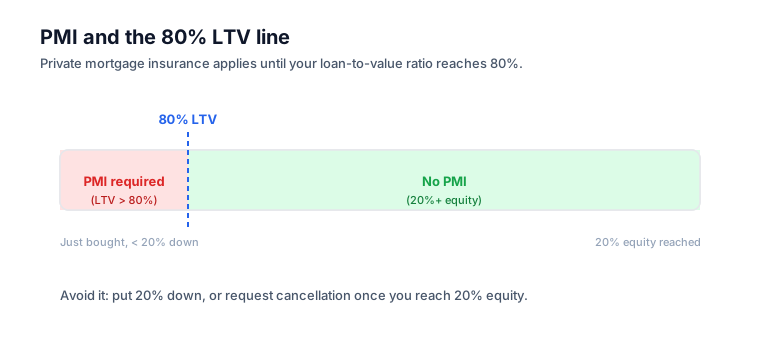
PMI is an insurance policy that pays out to your lender if you stop making payments and they have to foreclose. You're the one writing the check every month, but the coverage is theirs. As the Consumer Financial Protection Bureau puts it, PMI is something "you might be required to buy if you take out a conventional loan with a down payment of less than 20 percent" — and it "does not protect you," meaning you can still lose the home to foreclosure if you fall behind.
Why do they require it? Risk. When you put down less than 20%, the lender is financing a bigger slice of the home's value. If you default early and they have to sell the place — often in a hurry, sometimes in a down market — they're far more likely to come up short on a loan where you only put 5% or 10% down. PMI is how they offset that risk, and they pass the cost straight to you.
That's the whole logic. Smaller down payment, riskier loan, so the lender insures itself on your dime until you've built up enough equity that the risk fades.
How Much Does PMI Cost Per Month?
PMI usually runs somewhere between 0.46% and 1.5% of the loan amount per year, billed monthly. Freddie Mac frames it as roughly $30 to $70 a month for every $100,000 you borrow. Where you land in that range depends on a few things:
- A smaller down payment (say 5%) costs more PMI than a larger one (15%).
- A higher credit score earns a lower PMI rate.
- The loan term and product type shift it too.
A range of percentages doesn't mean much until you see it in dollars, so here's a concrete case. Take a $360,000 loan — that's a $400,000 home with 10% down — at a 0.5% PMI rate:
Annual PMI  = $360,000 × 0.5% = $1,800
Monthly PMI = $1,800 / 12 = $150
That's $150 a month buying you nothing. It's pure cost until you can cancel it. Stretch that over the few years it usually takes to reach 20% equity and you're looking at $5,000 to $15,000 total — real money that did nothing for your own balance sheet.
PMI is one of the four parts of your monthly housing cost — for how it stacks up against principal, interest, taxes, and insurance, see mortgage PITI explained.
When Can You Remove PMI?
PMI isn't permanent — the federal Homeowners Protection Act gives you three exits, and it's worth knowing all three because the fastest one requires you to actually ask. These rules apply to most loans closed after July 29, 1999.
Request cancellation at 80% LTV. Per the CFPB, you have the right to ask your servicer to cancel PMI on the date your principal balance is scheduled to fall to 80% of the home's original value. You'll need to make the request in writing, have a good payment history, be current on payments, confirm there are no junior liens, and may need an appraisal showing the value hasn't dropped. This is the fastest route.
Automatic termination at 78% LTV. If you don't ask, the servicer must terminate PMI on its own once your balance is scheduled to reach 78% of the original value — as long as you're current. You don't have to do anything; it happens through normal payments over time.
The loan midpoint. If neither of those has kicked in, PMI must end the month after you reach the midpoint of your loan's amortization schedule — year 15 of a 30-year loan, regardless of where your LTV sits.
One important caveat: all of this applies to conventional loans. FHA loans run on a different system called MIP (Mortgage Insurance Premium), which carries a 1.75% upfront premium plus an annual charge. Under current HUD rules, if you put less than 10% down, FHA MIP lasts the life of the loan — you can't shed it without refinancing out of the FHA loan entirely. Put 10% or more down and it drops off after 11 years. If you're weighing an FHA loan, factor that in: the insurance can follow you far longer than conventional PMI.
How to Avoid PMI Entirely
There's more than one way to skip PMI, and the right choice depends on how much cash you have and how long you plan to stay.
Put 20% down. The obvious route. Twenty percent down means no PMI from day one. On a $400,000 home, that's $80,000. The math is clean, but saving that much takes time, and in a rising market home prices can climb faster than your savings — which is a real cost the "just save more" advice tends to ignore.
Lender-paid PMI (LPMI). Some lenders offer to "cover" your PMI in exchange for a slightly higher interest rate. The cost gets baked into the rate instead of showing up as a separate line. This can work out cheaper if you're only holding the loan a few years. Over the long haul it's usually more expensive, because that higher rate sticks around for the entire loan while ordinary PMI drops off once you hit 20% equity.
The piggyback loan (80/10/10). Here you take a first mortgage for 80% of the price, a second loan (a HELOC or home equity loan) for 10%, and put 10% down yourself. Because the first mortgage sits at 80% LTV, no PMI is required. The catch: that second loan usually carries a higher rate, and you're now juggling two payments.
Just pay it. This sounds like giving up, but it's sometimes the sharpest move. Suppose you'd need two more years to save a full 20%, and prices in your market are rising 8% a year. You'd lose more to appreciation than you'd ever pay in PMI. PMI lets you buy now, at today's price. Run the numbers for your own market before you assume waiting is the frugal choice.
The PMI vs. Opportunity Cost Trade-off
Here's a point most PMI articles skip entirely. Putting 20% down ties up a large pile of cash. Suppose instead you:
- Put 10% down (and pay PMI), and
- Invest the other 10% at, say, a 7% annual return
Now the comparison isn't "PMI vs. no PMI." It's the PMI cost (roughly 0.5% a year on the loan) against the return on the cash you kept invested (7% a year). In that framing, paying PMI and investing the difference can genuinely come out ahead — if you actually invest the money and if the market cooperates. (The reason this works is the same force behind any long-term investing math; see compound interest explained for why a steady 7% snowballs.)
This isn't financial advice, and both of those "ifs" matter. But it's exactly why "always put 20% down" is an oversimplification. The honest answer depends on your rate, your PMI cost, your expected returns, and how much risk you can stomach.
A complete example
Here's a $400,000 home, side by side: 10% down with PMI versus 20% down without it.
| 10% down | 20% down | |
|---|---|---|
| Down payment | $40,000 | $80,000 |
| Loan amount | $360,000 | $320,000 |
| P&I (6.75%, 30yr) | $2,335 | $2,076 |
| PMI (0.5%) | $150 | $0 |
| Monthly total | $2,485 | $2,076 |
| Cash kept | $40,000 | $0 |
The 10%-down buyer pays $409 more each month but holds onto $40,000 in cash. And PMI isn't forever here — once they reach 20% equity through payments and any appreciation, it falls off, and the gap shrinks to just the difference in principal and interest. If you want to understand where that P&I figure comes from, how mortgage payments are calculated walks through the amortization math behind the table.
The bottom line
PMI protects your lender, not you, and it shows up whenever you put less than 20% down. Expect it to cost somewhere around 0.46% to 1.5% of the loan a year — roughly $30 to $70 a month per $100,000 borrowed. The upside is that it's removable — automatically at 78% LTV, or by request at 80%. You can sidestep it with a 20% down payment, a piggyback loan, or lender-paid PMI, or you can simply pay it when buying now beats waiting.
Before you commit either way, run your real numbers through the Mortgage Calculator and see exactly what PMI does to your payment.
This article is for educational purposes only and is not financial advice. PMI pricing, lender rules, and loan terms vary — consult a qualified mortgage professional or financial advisor about your specific situation.
Frequently asked questions
Is PMI tax-deductible?
Not for tax year 2025. The deduction lapsed after the 2021 tax year, so 2022 through 2025 returns cannot claim it. The One Big Beautiful Bill Act, signed July 4, 2025, restored the deduction permanently starting tax year 2026. Check current IRS guidance for your year.
Can I cancel PMI if my home value went up?
Yes. If appreciation pushes your equity past 20%, you can request cancellation with a new appraisal, even if the balance has not dropped to 80% of the original value. You generally must be current on payments and have a clean payment history to qualify.
Does refinancing remove PMI?
It can, if the new loan lands under 80% LTV based on current value. This is also the main way to escape FHA mortgage insurance. Weigh the refinance closing costs against the PMI you would save, since the math does not always favor it.
What is the difference between PMI and FHA MIP?
PMI is for conventional loans and cancels at 78%-80% LTV. FHA MIP is separate; it includes a 1.75% upfront premium plus an annual charge, and with less than 10% down it lasts the life of the loan. The only exit is usually refinancing into a conventional loan.
When does PMI automatically come off?
Under the Homeowners Protection Act, your servicer must terminate PMI when your balance is scheduled to hit 78% of the home's original value, as long as you are current. If that never triggers, it must end at the loan's midpoint anyway, year 15 of a 30-year loan.