PITI Explained: Where Each Dollar of Your Mortgage Goes
Principal, Interest, Tax, Insurance — your monthly mortgage payment broken into four parts, with worked examples and how PMI adds 0.3-1.5% per year.
The number you actually live with on a mortgage is the monthly payment. Lenders quote it as a single figure, like it's one clean charge. It isn't. That number is four separate things bundled together under one acronym: PITI — Principal, Interest, Tax, and Insurance.
The breakdown matters more than people expect, because those four parts behave nothing alike. One shrinks a little every month. One stays roughly flat for years. Two of them depend entirely on where you bought and what you bought. Once you know which dollar is doing what, comparing loan offers and building a realistic budget gets a lot easier — and you can spot when a quote looks off.
What does PITI stand for?
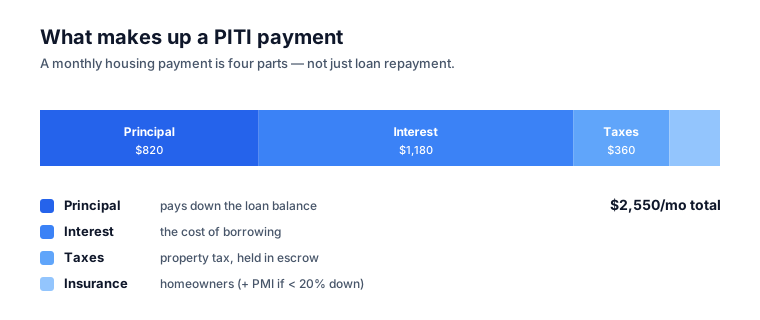
PITI stands for Principal, Interest, Tax, and Insurance — the four pieces of a monthly mortgage payment. Here's who each dollar goes to.
| Letter | What it pays | Who gets it |
|---|---|---|
| Principal | The loan balance | The lender (reduces what you owe) |
| Interest | The cost of borrowing | The lender (pure expense) |
| Tax | Property taxes | Local government |
| Insurance | Homeowners insurance | Insurance company |
In most cases these get rolled into one monthly payment that lands with your lender, who then forwards the tax and insurance pieces to the right parties through an escrow account. You write one check; the lender splits it up behind the scenes.
Principal: the part that builds equity
Principal is the slice of your payment that actually pays down the loan balance. Every dollar of it turns into a dollar of equity — value you genuinely own.
But there's a catch that surprises almost every new buyer. In the early years of a 30-year mortgage, the principal slice is tiny. Most of what you pay is interest. That ratio flips over time, but slowly.
Here's what it looks like on a $400,000 loan, 30-year term, 6.75% interest, with a payment around $2,594/month (principal and interest only):
| Year | Monthly principal | Monthly interest | % to principal |
|---|---|---|---|
| Year 1 | ~$345 | ~$2,249 | 13% |
| Year 10 | ~$640 | ~$1,954 | 25% |
| Year 20 | ~$1,260 | ~$1,334 | 49% |
| Year 30 | ~$2,580 | ~$14 | ~99% |
This "back-loaded equity" is the reason people in their first five years of a mortgage feel like they're throwing money away on interest. Honestly? They sort of are. By year 15 to 20, the picture turns around completely, and most of each payment finally starts chipping at the balance.
You can watch this curve bend with the Mortgage Calculator — change the loan amount or rate and see how the split shifts. For the math behind why the split moves the way it does, see how mortgage payments are calculated.
Interest: what you actually pay for the loan
Interest is the price of borrowing the money. It's recalculated every month against your remaining balance, which is exactly why the interest portion shrinks as the principal comes down.
The monthly rate is just your annual rate divided by 12. At 6.75% a year, that's 0.5625% a month. So in month one, on a $400,000 balance, the interest is 0.5625% × $400,000 = $2,250.
The next month the balance is a hair lower, so the interest is a hair lower, so slightly more of your payment goes to principal — and the cycle quietly speeds up from there.
One thing worth burning into memory: a quarter-point difference in rate is enormous over 30 years. On that same $400,000 loan:
- 6.50% → $2,528/month, $510k total interest
- 6.75% → $2,594/month, $534k total interest
- 7.00% → $2,661/month, $558k total interest
That 0.25% costs you $24,000 over the life of the loan. Shop your rate. Always.
Why does property tax vary so much by location?
Because it's set entirely by geography — the state, county, and assessed value behind your address, not anything about your loan. Property tax is the part of PITI you have the least control over. It depends on:
- Your state and county, where effective rates range from about 0.26% to 2.08% of home value per year
- Your assessed value, often lower than market value and set by the local assessor
- The local mill rate plus any special assessments
To see how wide that spread really is, look at effective rates around the country, using Tax Foundation data:
- Hawaii: ~0.26% (lowest in the US)
- California: ~0.7% (Prop 13 caps how fast it grows)
- Texas: ~1.6% (no state income tax, so property tax carries more weight)
- New Jersey: ~2.08% (highest in the US, followed by Illinois and Connecticut)
On a $500,000 home, that's the difference between roughly $1,300 a year ($108/mo) in Hawaii and $10,400 a year ($867/mo) in New Jersey — driven by nothing but location. Two buyers with identical homes and identical loans in different counties can end up with wildly different payments because of this one factor. It's the single most variable piece of PITI, so research the county before you fall in love with a house.
One offset worth knowing: if you itemize, property tax actually paid to the taxing authority is deductible, alongside mortgage interest, though state and local tax deductions are capped (IRS Topic 503). Most filers take the standard deduction, so don't bank on it.
Insurance: homeowners coverage
Homeowners insurance covers the structure (and usually your belongings) against fire, theft, weather, and liability. Lenders require it for a simple reason: the home is their collateral, and they're not about to let it sit uninsured.
Cost typically runs 0.25% to 0.5% of home value per year, and it moves with:
- Risk — wildfire, hurricane, and earthquake zones cost more
- Construction — wood frame versus concrete
- Your chosen deductible
- Credit score, where state law allows it in pricing
On a $500,000 home, that lands around $1,250 to $2,500 a year, or roughly $100 to $200 a month.
A word of warning: in high-risk areas like coastal Florida and California wildfire country, insurance has turned into a genuine problem. Some insurers have stopped writing policies altogether, and the ones still in the market have doubled or tripled their premiums since 2020. If you're buying in one of those zones, get a real quote early — don't budget off a national average.
The fifth letter: when does PMI fall off?
If your down payment is less than 20%, you'll usually carry Private Mortgage Insurance on top of PITI. PMI protects the lender (not you) if you default, and it's typically:
- 0.3% to 1.5% of the loan amount per year
- Charged monthly, folded into your mortgage payment
- Removed automatically once your loan-to-value ratio reaches 78% — and you can request removal at 80%
That auto-removal isn't a courtesy. It's federal law. Under the Homeowners Protection Act of 1998, your servicer "must automatically terminate PMI on the date when your principal balance is scheduled to reach 78 percent of the original value of your home," provided you're current on payments (CFPB). "Original value" means the lower of your purchase price or appraised value at the time you bought. You can also ask in writing to cancel once your balance is scheduled to hit 80% of that value — you don't have to wait for 78%.
Put numbers on it: a $400,000 loan with 10% down, at a 0.5% PMI rate, costs $400,000 × 0.5% = $2,000 a year, or $167 a month. For more ways to dodge it, see what PMI is and how to avoid it.
This is why "put 20% down" gets treated as the goal — it kills a $100-to-$300 monthly expense that delivers you zero value. That said, the goal isn't sacred. If saving for another year to reach 20% means buying into a market that rose 8% in the meantime, you've lost more than the PMI would have cost.
What's NOT in PITI
A handful of costs sit outside PITI entirely, and they regularly blindside first-time buyers.
HOA fees. If your home is in an HOA, the dues — often $100 to $500 a month, sometimes north of $1,000 for condos — are paid separately, not through your lender.
Utilities. Electricity, water, internet, gas. All separate, all yours.
Maintenance. The rough industry rule is 1% of home value per year. On a $500,000 home that's about $5,000 annually, roughly $416 a month — though it never arrives evenly. You'll get three quiet years and then a $20,000 roof.
Closing costs. One-time fees at purchase, usually 2% to 5% of the loan amount, covering appraisal, title insurance, taxes, lender fees, and the rest. They don't touch your monthly payment, but they're very real cash up front.
A complete example
Say you're eyeing a $500,000 home in Texas: 10% down, 7% interest, 30-year term, property tax at 1.6%, insurance at $1,800/year, PMI at 0.5%. Here's how the monthly payment actually breaks down.
| Component | Monthly |
|---|---|
| Principal + Interest | $2,994 |
| Property Tax | $667 |
| Insurance | $150 |
| PMI | $188 |
| Total PITI(+PMI) | $3,999 |
That $3,999 is the number to budget around — nearly $1,000 a month more than principal and interest alone. Plug your own figures into the Mortgage Calculator to see your breakdown. For a simpler principal-and-interest view on any kind of loan, not just mortgages, the Loan Calculator does the job.
How to actually use this
Knowing the four letters is only useful if it changes how you shop and budget. A few ways it should:
Comparing lenders. Compare total PITI plus PMI, not just the headline rate. A lender with a higher rate but lower fees can be the cheaper deal. And don't be spooked by escrow — a lender bundling your tax and insurance isn't hiding anything, you're paying the same costs either way.
Budgeting. The classic guideline is 28/36: keep monthly housing (PITI + PMI + HOA) under 28% of gross income, and total debt payments under 36%. The CFPB cites 28% as a housing rule of thumb, and qualified-mortgage rules let many lenders approve total debt up to 43% — but that's a tight, stressful place to live.
Choosing a down payment. Weigh the PMI cost against the opportunity cost of the cash. If you could earn 7% in index funds and PMI runs 0.5%, putting less down and investing the difference can win — at the cost of holding less in liquid savings if something goes sideways.
Planning extra payments. Early extra payments are wildly efficient. Every extra dollar toward principal in year one saves you roughly $3 in interest over the life of a 30-year loan at 7%. The earlier the dollar lands, the more it compounds in your favor — the same force at work in compound interest, just running in your direction for once.
The bottom line
PITI is Principal, Interest, Tax, and Insurance — the four parts of your monthly payment — plus PMI as a fifth whenever you put down less than 20%. Principal and interest are fixed by the loan itself; tax and insurance swing dramatically with location, and property tax is the biggest wildcard of all. When you shop, compare full PITI rather than the rate alone, and before you commit to anything, run your specific numbers through a mortgage calculator.
This article is for educational purposes only and is not financial advice. Mortgage rates, insurance costs, and property tax rules vary by lender and location — consult a qualified mortgage professional or financial advisor about your specific situation.
Frequently asked questions
What does PITI stand for?
PITI stands for Principal, Interest, Tax, and Insurance — the four components of a monthly mortgage payment. Principal pays down the balance, interest is the cost of borrowing, tax is property tax, and insurance is homeowners coverage. Lenders usually bundle all four into one payment through an escrow account.
When does PMI fall off?
Under the federal Homeowners Protection Act, your servicer must automatically terminate PMI on the date your balance is scheduled to reach 78% of the original home value, if you are current on payments. You can request cancellation earlier, at 80% loan-to-value, in writing.
What is the 28/36 rule?
The 28/36 rule is a common affordability guideline: keep monthly housing costs (PITI plus PMI and HOA) under 28% of gross income, and total monthly debt under 36%. The CFPB cites 28% as a housing rule of thumb. Many lenders approve total debt up to 43% under qualified-mortgage rules.
Which states have the highest property taxes?
New Jersey has the highest effective property tax rate at about 2.08% of home value, followed by Illinois and Connecticut. Hawaii is lowest at roughly 0.26%, per Tax Foundation data. On a $500,000 home, that gap is over $9,000 a year driven by location alone.
Is PITI tax deductible?
Only parts of it. If you itemize, mortgage interest and the property tax actually paid to the taxing authority are deductible per IRS rules, though state and local tax deductions are capped. Principal, homeowners insurance, and PMI are generally not deductible. Most filers take the standard deduction instead.