Compound Interest Explained: How Your Money Grows Over Time
How compound interest works, the A=P(1+r/n)^nt formula, why starting early beats investing more, the Rule of 72, and how $10,000 at 7% becomes $81,165.
Compound interest might be the most important idea in personal finance, and it's almost certainly the most underrated. It's the reason a 25-year-old putting away $200 a month can end up richer than a 35-year-old socking away $400 a month. That sounds like a trick. It isn't — it's just the math, and once you see it clearly, it changes how you think about money.
Let's start with what makes compound interest different from the simple kind, then look at the formula, and finally at why time turns out to matter more than the amount you invest.
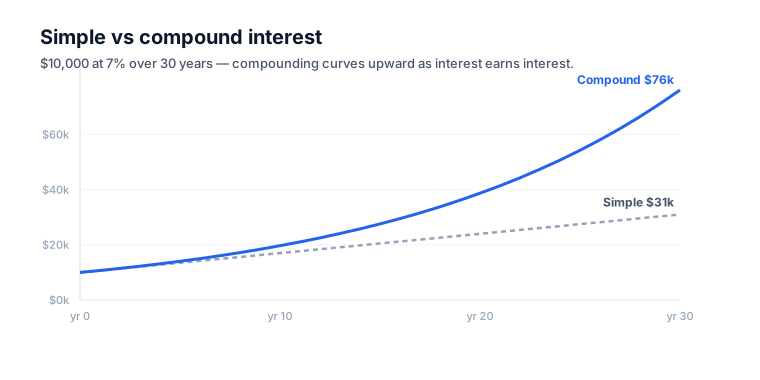
Simple vs. compound interest
Compound interest earns returns on your returns; simple interest earns returns only on your original principal. The SEC's investor education site puts it in five words: compound interest is "interest paid on principal and on accumulated interest". That second part — interest on your interest — is the entire difference.
Simple interest is calculated only on your original principal:
$1,000 at 10% simple interest for 3 years:
Year 1: $1,000 + $100 = $1,100
Year 2: $1,100 + $100 = $1,200
Year 3: $1,200 + $100 = $1,300
You earn a flat $100 every year, forever. Predictable, but it never picks up speed.
Compound interest is calculated on the principal plus every dollar of interest you've already earned:
$1,000 at 10% compound interest for 3 years:
Year 1: $1,000 × 1.10 = $1,100
Year 2: $1,100 × 1.10 = $1,210
Year 3: $1,210 × 1.10 = $1,331
Over three years the gap looks trivial — $1,331 versus $1,300. But that gap doesn't grow steadily. It widens exponentially. Stretch the timeline out and the difference stops being a rounding error and starts being life-changing. That's the whole magic, and it's all in the math.
The compound interest formula
The formula for compound growth is A = P(1 + r/n)^(nt) — final amount equals principal times one plus the periodic rate, raised to the number of compounding periods. It's the same math the SEC bakes into its free compound interest calculator.
A = P(1 + r/n)^(nt)
Where:
- A = final amount
- P = principal (starting amount)
- r = annual interest rate (as a decimal)
- n = number of times interest compounds per year
- t = number of years
Let's run a real one. Take $10,000 at 7%, compounded monthly, for 30 years:
A = 10,000 × (1 + 0.07/12)^(12 × 30)
A = 10,000 × (1.005833)^360
A = 10,000 × 8.116
A ≈ $81,165
Your $10,000 grew into $81,165 — and you never added another dollar. That's $71,165 of pure compound growth doing the work for you. Try your own starting amounts and rates with the Compound Interest Calculator.
Why starting early beats investing more
Starting early beats investing more because time, not contribution size, is the variable that compounds. This is the part that genuinely changes lives once it clicks. Picture two investors.
Early Emma invests $200 a month from age 25 to 35 — ten years, $24,000 total — then stops cold and never contributes again. She just lets it ride until 65.
Late Larry invests $200 a month from age 35 all the way to 65. That's 30 years and $72,000 in.
Both earn 7% a year. Who's ahead at 65?
| Total invested | Value at 65 | |
|---|---|---|
| Early Emma | $24,000 | ~$300,000 |
| Late Larry | $72,000 | ~$245,000 |
Emma put in a third of what Larry did and still ended up with more. Her ten years of early contributions had 30-plus years to compound, while Larry's bigger contributions never got the same runway. This is why financial advisors practically beg people to start early: time in the market beats amount in the market, and it isn't close.
The Rule of 72
The Rule of 72 estimates how many years your money takes to double: divide 72 by your annual return rate. It's a back-of-the-napkin shortcut, not exact, but it's close enough to reason about in your head.
72 / 7% = ~10.3 years to double
72 / 10% = 7.2 years to double
72 / 4% = 18 years to double
At 7%, $10,000 becomes $20,000 in about a decade, $40,000 in 20 years, $80,000 in 30. Notice that each doubling adds more in raw dollars than every prior doubling combined — that's the exponential curve doing its thing.
Compounding frequency matters (a little)
Compounding frequency affects your return, but far less than most people assume. The n in the formula — how often interest compounds — moves the final number only at the margins. Here's $10,000 at 7% for 30 years, sliced by compounding frequency:
| Frequency | Final amount |
|---|---|
| Annually (n=1) | $76,123 |
| Quarterly (n=4) | $80,466 |
| Monthly (n=12) | $81,165 |
| Daily (n=365) | $81,609 |
Going from annual to monthly adds about $5,000. Going from monthly to daily adds maybe $450. The rate and the time horizon matter enormously; the frequency barely moves the needle. Most savings accounts compound daily, and most investment returns are quoted annually — so don't lose sleep over this knob.
Adding regular contributions
Regular contributions compound on top of your principal, so the real-world math stacks two growth curves at once. In practice you usually invest a steady stream, not one lump sum: the future value combines the growth of your starting principal plus the growth of an annuity — your ongoing deposits. The Compound Interest Calculator handles both at once, so you can enter a starting amount and a monthly contribution and model a realistic retirement or savings plan.
Here's what that looks like: $10,000 to start, plus $500 a month for 30 years at 7%.
Principal growth:    $10,000 → ~$81,000
Contributions:       $500/mo × 360 = $180,000 deposited
Contribution growth: ~$610,000
Total:               ~$691,000
You deposited $190,000 over those years and walked away with about $691,000. That $500,000 gap? All compound interest.
The dark side: compound interest works against you too
Compound interest works against you on debt with the exact same relentless math it uses to build your investments. On credit cards especially, it compounds the balance up instead of your savings.
Credit card rates are punishing right now. Per the Federal Reserve's G.19 Consumer Credit release, the average APR on accounts assessed interest was about 21.5% in early 2026 (roughly 21% across all accounts). At that rate, a $5,000 balance paid at only the minimum can take well over a decade to clear and cost thousands of dollars in interest alone. You can model the payoff on any loan with the Loan Calculator.
Which leads to a counterintuitive but rock-solid rule: paying off high-interest debt is often the best "investment" you can make. Clearing a ~21% credit card is a guaranteed ~21% return — far better than the ~10% nominal you'd hope for from the stock market, and with zero risk. The same logic applies to other debt you carry. If you have a mortgage, it's worth understanding how the payment is calculated and what PITI actually covers before deciding where extra dollars do the most good.
Nominal vs. real returns
Every number above is nominal, meaning it ignores inflation. Your real return — your actual purchasing power — is the nominal rate minus inflation. The S&P 500 has averaged roughly 10% nominal per year over the long run, but after inflation that historically works out closer to 7%.
For long-term planning, subtract your expected inflation rate from your return rate to see growth in today's dollars. That $691,000 in 30 years won't buy what $691,000 buys right now, and pretending otherwise sets you up for disappointment. The same gotcha shows up in housing costs too — things like PMI on a low-down-payment mortgage quietly eat into the money you could otherwise be compounding.
The bottom line
Compound interest earns returns on your returns, which is what turns steady saving into exponential growth over time. The formula, A = P(1 + r/n)^(nt), is worth knowing, but the lesson behind it matters more: starting early beats investing more, because time is the single most powerful variable you control. Use the Rule of 72 to estimate doubling time, remember that the same math works against you on high-interest debt, and model your own numbers before you commit to a plan.
This article is for educational purposes only and is not financial advice. Investment returns are not guaranteed, past performance does not predict future results, and you should consult a qualified financial professional about your specific situation.
Frequently asked questions
What return rate should I assume for planning?
The S&P 500 has averaged roughly 10% nominal per year over the long run (about 7% after inflation), but with brutal year-to-year swings. Many planners use a more conservative 6 to 7% so a few bad years do not wreck the projection. Lower assumptions are safer.
Is compound interest guaranteed?
For savings accounts, CDs, and bonds, the rate is fixed and growth is locked in. For stock-market investments, returns bounce around year to year and the average only holds over long periods. Never count on an average return for a short time horizon — sequence matters.
How do I actually start compounding?
Tax-advantaged accounts such as a 401(k), an IRA, or the equivalent in your country are usually the smartest first stop. They let your money compound without an annual tax bite on the gains, which meaningfully lifts your long-run balance compared with a taxable account.
How often should money compound?
More frequent compounding helps, but only a little. On $10,000 at 7% over 30 years, switching from annual to monthly compounding adds about $5,000, while monthly to daily adds roughly $450. The rate and time horizon matter far more than the frequency.