JSON vs XML vs YAML: Which Data Format Should You Use?
JSON, XML, and YAML compared on syntax, readability, and real use cases. YAML 1.1 has 22 ways to write a boolean — here is exactly when to pick each one.
JSON, XML, and YAML all do the same fundamental job: represent structured data as text. But they make very different trade-offs, and picking the wrong one for a task leaves you with verbose configs, parsing headaches, or whitespace bugs that take an afternoon to find. The fastest way to understand the differences is to see the exact same data in all three — so that's where we'll start.
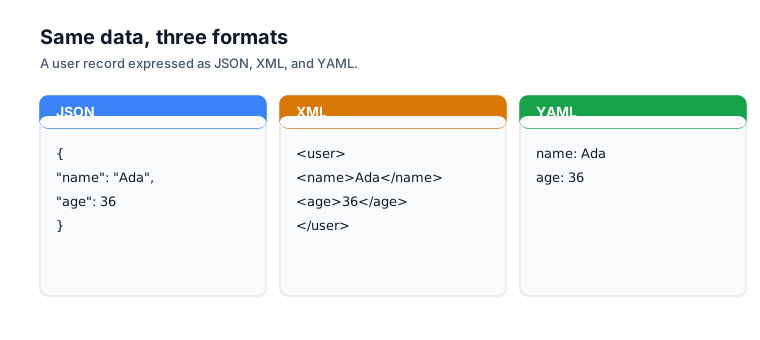
The same data, three ways
Here's a small user record written out in each format.
JSON:
{
  "name": "Alice",
  "age": 30,
  "roles": ["admin", "editor"],
  "active": true
}
XML:
<user>
  <name>Alice</name>
  <age>30</age>
  <roles>
    <role>admin</role>
    <role>editor</role>
  </roles>
  <active>true</active>
</user>
YAML:
name: Alice
age: 30
roles:
  - admin
  - editor
active: true
Same information, three philosophies. JSON is compact and ubiquitous. XML is verbose and explicit. YAML is minimal and built for human eyes.
JSON: the web's default
Pick JSON when programs are talking to programs. It (JavaScript Object Notation) won the web, plain and simple — it's the default for REST APIs, the format behind package.json and countless config files, and it's natively supported by virtually every language going.
Its strengths are exactly why it spread: it's compact and fast to parse, it's native to JavaScript via JSON.parse and JSON.stringify, it's universally supported, and the spec is genuinely tiny. The whole grammar fits on a single page — the ECMA-404 standard defines the entire syntax with a handful of railroad diagrams and nothing else.
The weaknesses are real but narrow. There are no comments, which is a genuine pain for config files. The syntax is strict, so trailing commas and unquoted keys fail outright. It gets verbose for deeply nested or repetitive data. And it has no native date or binary type.
In practice that makes JSON the safe default for APIs, service-to-service data, and any config that doesn't need comments. When you're knee-deep in a payload, the JSON Formatter makes it readable and the JSON Validator confirms it parses; a quick scan of the most common JSON errors catches the rest.
XML: the enterprise veteran
Reach for XML when you need rich document structure and strict validation. XML (eXtensible Markup Language) predates JSON — it's been a W3C Recommendation since 1998 — and still rules in enterprise software, finance (think SOAP APIs), document formats like DOCX, SVG, and RSS, and a long tail of legacy systems.
What XML brings that JSON doesn't is structural richness. It supports attributes plus nested elements, giving you more shape than JSON's flat key-value pairs. Its schemas (XSD) offer strict, mature validation. Namespaces let you avoid naming collisions in large documents. Comments are supported. And it has excellent tooling for transformation (XSLT) and querying (XPath).
The cost is verbosity and complexity. Every value gets wrapped in an opening and closing tag, which makes XML harder to read and write by hand and heavier to parse. There's even a perennial design argument baked in: should a given piece of data be an attribute or an element?
None of that makes XML a bad choice — it makes it a specialized one. Where the payoff is real (validated documents, mixed content, transformation pipelines), the verbosity buys you something. Where it isn't, you're paying overhead for power you'll never use.
YAML: the config favorite
Use YAML when a human is going to read and edit the file. YAML (YAML Ain't Markup Language) optimizes hard for that one goal, which is why it's the config format of choice for Docker Compose, Kubernetes, GitHub Actions, Ansible, and most CI/CD pipelines.
The appeal is its minimal syntax — no braces, no quotes most of the time, no closing tags. It supports comments with #, it reads beautifully for configuration, and a stated goal of the YAML 1.2 specification was making YAML a strict superset of JSON. Any valid JSON is therefore valid YAML.
The weaknesses, though, are earned. YAML is whitespace-significant: indentation errors are real bugs, and tabs-versus-spaces actually matters. Its type coercion guesses wildly — no becomes false, 1.0 becomes a float, and version 1.10 can silently turn into 1.1. The grammar carries far more surface area than JSON's, and the sharpest edge of all is the "Norway problem," where the country code NO parses as the boolean false. That's no exaggeration: under the older YAML 1.1 rules, there are 22 distinct spellings of true and false, including yes, on, and off.
So YAML is brilliant for hand-edited config and a poor fit for two things in particular: data interchange between programs, where JSON is faster and safer, and untrusted input, where that complex grammar becomes an attack surface you don't want to expose.
Head-to-head comparison
| Feature | JSON | XML | YAML |
|---|---|---|---|
| Readability | Good | Poor | Excellent |
| Verbosity | Low | High | Lowest |
| Comments | ❌ No | ✅ Yes | ✅ Yes |
| Schema validation | Add-on (JSON Schema) | ✅ Mature (XSD) | Add-on |
| Whitespace-sensitive | No | No | ⚠️ Yes |
| Parse speed | Fast | Slower | Slower |
| Native JS support | ✅ Built-in | No | No |
| Best for | APIs, data | Documents, enterprise | Config |
When to choose which
Deciding under pressure? One question usually settles it: who reads the file, a program or a person?
JSON is your answer whenever a program is on both ends. Web APIs, service-to-service messaging, anything that needs universal language support, data that's generated and consumed by machines rather than typed by hand — that's JSON's territory, and it's rarely a close call.
XML earns its place the moment structure and validation stop being optional. SOAP integrations and enterprise systems expect it. Schema validation via XSD demands it. Document formats — SVG, RSS, Office files — are built on it. And if namespaces or attributes genuinely matter to your data, nothing else competes.
That leaves YAML, which shines in exactly one situation: a human is going to open the file and edit it. Configuration, CI/CD pipelines, infrastructure-as-code — anywhere hand-editing and inline comments matter more than parse speed, YAML is the comfortable choice.
Converting between them
Conversion is usually straightforward, since all three represent similar structures — but every direction carries a gotcha worth knowing before you trust the output:
- JSON → YAML is clean, since YAML is a JSON superset.
- YAML → JSON loses comments, and watch for those type-coercion surprises.
- XML → JSON is ambiguous, because XML attributes versus elements don't map cleanly to JSON's flat key-value model.
- JSON → XML forces you to invent a structure — what becomes an attribute, and what becomes an element?
Converting into JSON? It's worth re-indenting the result so you can actually read it — our guide on how to format JSON walks through indentation and minification.
The YAML type-coercion trap
This one deserves a second mention, because it bites everyone eventually. YAML tries to guess types for you, and the guesses can be wild:
country: NO        # → false (the boolean!)
version: 1.10      # → 1.1 (parsed as float)
zip: 01234         # → 1234 (leading zero dropped) or string, depending
time: 22:22        # → could be parsed as sexagesimal number
yes_no: yes        # → true
The defense is simple: quote ambiguous values, as in country: "NO". Newer parsers built on the YAML 1.2 core schema narrow the boolean set down to just true and false, but plenty of tooling still leans on the older 1.1 rules — so quoting remains the only portable fix. This whole category of bug just doesn't exist in JSON, where everything is explicit by design.
The bottom line
JSON is compact and universal — the default for APIs and data interchange. XML is verbose but genuinely powerful, with schemas, namespaces, document formats, and deep enterprise roots. YAML is minimal and readable, the favorite for config and CI/CD, as long as you respect its whitespace and type-coercion quirks. Choose by use case: data leans JSON, documents and enterprise lean XML, configuration leans YAML. And if you're working with JSON, the JSON Formatter and JSON Validator are right here when you need them.
Frequently asked questions
Is YAML faster than JSON?
No — JSON parses faster. JSON has a tiny, unambiguous grammar that maps almost directly to native objects, so parsers are simple and quick. YAML supports anchors, multiple document styles, and rich type coercion, all of which add work. For high-volume data interchange, JSON is the faster choice.
Can I use JSON inside a YAML file?
Yes. The YAML 1.2 specification was explicitly designed to make YAML a strict superset of JSON, so any valid JSON is also valid YAML. That lets you drop inline flow-style data like {"a": 1} straight into a YAML config when block style would be too verbose.
Why do web APIs use JSON instead of XML now?
JSON is less verbose, parses faster, and maps directly to JavaScript objects, which made it a natural fit as the web shifted to JavaScript-heavy front ends through the 2010s. XML still dominates SOAP services and document formats, but for everyday REST APIs, JSON became the default.
What is the YAML Norway problem?
In YAML 1.1, the unquoted scalar NO is interpreted as the boolean false, so a country-code list with NO for Norway breaks. YAML 1.1 actually allows 22 spellings of true and false, including yes, on, and off. Quoting the value as "NO" fixes it.
Does XML still matter in 2026?
Yes. XML underpins SOAP web services, SVG graphics, RSS feeds, and Office formats like DOCX and XLSX, and it remains the W3C Recommendation it has been since 1998. JSON replaced it for most REST APIs, but anywhere strict schema validation or document markup is required, XML is still the standard.